Tuesday, January 10, 2023

The Seven Arts of the CHURCH

 An ACOLYTE is any member of the CHURCH intending to become an INITIATE, the title for someone trained in one of the 7 Clerical Arts. It takes a year of dedicated study under a High INITIATE mentor to consider oneself proficient in a given Art. One can be granted the title of High INITIATE after successfully practicing their Art for 13 more years. There are six types of INITIATE, from First Circle to Sixth Circle. Each Art you have studied raises you a Circle. (For example, a High Third Circle INITIATE has mentored in 3 arts, and has practiced at least one for 13 years.) There is no such thing as a Seventh Circle INITIATE, as 7 is the forbidden number; such a position is held by a HIEROPHANT, of which there are only ever 3. Below are short descriptions of each Art, and the title one receives upon having completed their mentorship.


ACOLYTE [Make the world better] d6. Institutional protectorate (assaulting an acolyte is a heretical offense).

INITIATE [Serve the CHURCH] d8. Institutional protectorate, unshakeable will (mental state cannot be magically swayed), Art practitioner (see italics below).


(Pb now has a minimalist stat format! NAME [Impulse] VD. Special abilities. SOMA is twice the max value of the VD, WD are listed next to any abilities that use them. That new terminology will make sense when I publish the next version of NEW AGE.)


A Cantor practices Binding. This is the easiest Art to study, and generally the first that the average ACOLYTE pursues, as it’s oriented around ceremonies whose intricacies are tedious but not complex. The three primary ceremonies of Binding are the Mystery (in which the CHURCH recognizes and sanctions the promotion of a clergymember), the Wedding (in which the CHURCH recognizes and sanctions the crystallization of a romance), and the Indictment (in which the CHURCH recognizes and sanctions a declaration of heresy). A Cantor can freely change anyone’s emotional state by speaking to them for a minute, or by touching them for a High Cantor.


Many who learn the vulgar rites graduate to learn rituals yet graver.


A Celebrant practices Internment. The Celebrant deals with the dead, officiating funerals and executions with equal gravity and vindictive zeal. Children who rip small animals limb from limb and snap their bones inside their flesh are often introduced to their local Celebrant in the hopes of a future apprenticeship. A Celebrant’s touch takes up to a year off of your life, or up to a decade for a High Celebrant.*


Those who must deal with heresy’s aftermath often seek preventative approaches.


An Abjurer practices Abjuration (called Apotropaia when practiced by a heretic). When holy ground must be consecrated or spirits from beyond must be exorcized, these tight-lipped, cerulean-clad nomads slip in, work their artifice, and silently vanish as mysteriously as they first came. Hunting down a High Abjurer mentor is part of an ACOLYTE’S training. An Abjurer’s glare quells magic, and paralyzes for a High Abjurer.


When salt and script fail, often steel and sinew succeed.


A Bulwark practices Crusade. Crusade is the only act of CHURCH-sanctioned violence, and is to be exerted only against heretics and existential threats to the CHURCH and its holdings, at least on paper. Bulwarks traditionally use blood-polished shillelaghs grown in an ankh shape; part of their training is to find a suitable staff and crack enough skulls with it to get a good claret stain. Bulwarks have a d10 VD, or a d12 for a High Bulwark.


The old wisdom is to avoid breaking what you cannot mend.


A Chaplain practices Healing. Is their miraculous artifice the result of divine providence or the cutting edge of learning? None can be sure, but none can argue its near-preternatural efficacy. However, the CHURCH does not practice mercy-killing; many cripples in its care commit heinous sins just so they may be finally made free from agony’s shackles at a Celebrant’s hands. Chaplains can replenish 1 SOMA through their touch, or WD (d6) for a High Chaplain.


Those who suffer supplicate to their superiors so they may soothe their spirits.


An Augur practices Augury (called Divination outside of INITIATE practice). The means by which an Augur tells the future is a sort of regional dialect; be it by animal entrails, rune stones, cards, or cloud formations, be it under the star-speckled sky or deep within the earth, be it to conjure the whispers of the dead, visions from beyond, or metered glossolalia. Through these nuances, a knowledgeable Augur can watch another’s technique and know who their mentor was mentored by, and so on all the way back to the first practitioners of the Art. With an hour’s ritual and an appropriate sacrifice, an Augur receives a divine answer to a binary question, or an open-ended question for a High Augur. 


Those who know history are doomed to see it repeated.


A Counselor practices Cataloguing. The duties of a Counselor are eclectic, including overseeing confessionals and musically accompanying services, but their first is as the CHURCH’s living library. Their training involves memorizing large swathes of the Codex Periodicum word for word, and reading countless other folk fables and historical treatises to boot. It is for this reason that ex-Counselors, of which there are disproportionately many, are considered among the most dangerous heretics. With a glance, a Counselor knows everything you’ve done in the past day, or in the past year for a High Counselor.


*If you need a character’s expected lifespan in a pinch, 10+4d20 feels right to me for a medievalish setting.


(DESIGN NOTES: The strength of this design is that temperament = title = stats. For example, take a Second Circle INITIATE in Internment and Crusade. Not only does that diegetic title alone inform a complete stat block, it tells us a few things about their personality and background as a character. We can guess that they’re young, given they’re not a High INITIATE, and that they likely have a sadistic streak. This means that you the DM can encode a lot of information that might be expressed in redundant ways very succinctly, freeing physical and mental space for more interesting prep, and the players can access it through color heraldry and NPCs being addressed by their titles.)


Pb NEW AGE revision coming as soon as I have to get it finished in order to get this new game up and running. Thanks for reading, and happy gaming.

Tuesday, January 3, 2023

Dungeon fantasy's traditional/archetypal spells

 This is an effort to create the resource I’ve been wanting to see. Whenever I’ve been creating spell lists, especially minimalist ones, I’ve always worried that I’ve left off something necessary or oft-expected. To solve that problem, I’ve gone through my library of fantasy RPGs and recorded all the spell effects that recur enough to be noteworthy. The ultimate thesis I came to is this: these are the 10 categories of magic that most frequently recur in medieval fantasy dungeoneering games, and as such a well-rounded spell list should have at least one of each type of spell to feel like it covers all the bases. Below, each category is expounded into its relevant tropes and archetypes for an individual designer to adopt or reject at their leisure. If I forgot anything, please let me know in the comments. I want this to be as complete a resource I can make it (for very selfish reasons.)


ARCHETYPAL SPELL “SCHOOLS”:

1 Elemental magic

2 Enchantment magic

3 Social magic

4 Summoning magic

5 Divine magic

6 Health magic

7 Illusion magic

8 Sensory magic

9 Movement magic

10 Dungeon magic


ELEMENTAL

  • HARMFUL ELEMENTAL
    • Elemental damage (prominently fireball, lightning bolt, and magic missile)
    • Gas cloud, obfuscating and poisonous
    • Weather control/magical weather (particularly ice storms, earthquakes, and insect plagues)
  • UTILITY ELEMENTAL
    • Elemental wall (prominently fire and stone)
    • Elemental resistance
    • Elemental form
    • Produce/destroy water
    • Manipulate earth


ENCHANTMENT

  • OBJECT ENCHANTMENT
    • Mending
    • Invulnerability
    • Ensorcel item (particularly weapons)
    • Create item (particularly food/drink and magic items)
  • BODY ENCHANTMENT
    • Stat boost
    • Size manipulation (particularly plant hypergrowth)
    • Shapeshift (particularly into animals)
    • Incorporeality


SOCIAL

  • CHARM
    • Make friendly
    • Single-word command
    • Long-term command
    • Induce confusion/insanity
  • NONVIOLENCE
    • Read/speak language
    • Compel truth
    • Induce sleep

SUMMONING

  • NATURAL CREATURES
    • Familiar
    • Beast/swarm/steed
    • Monster
  • SUPERNATURAL CREATURES
    • Elemental
    • Demon
    • Angel/hero
    • Exorcism/banishing
  • EXOTIC SUMMONS
    • Animate objects
    • Invisible servant/familiar

DIVINE

  • INFLUENCE
    • Turn of fortune, good and ill
    • Manifestation/summoning of spiritual entity
  • DIVINATION
    • Question, binary and open-ended
    • Conversation with spiritual entity


HEALTH

  • WEAL
    • Heal wounds
    • Heal ailments (diseases, curses, handicaps, etc.)
    • Raise from dead
  • WOE
    • Inflict ailment (diseases, curses, handicaps, etc.)
    • Necrotic/vampiric touch
    • Reanimate as undead (particularly zombies and skeletons)


ILLUSION

  • GENERAL
    • Monosensory
    • Polysensory (particularly terrain)
    • Obfuscation (particularly darkness, invisibility, and silence)
  • SPECIFIC
    • Appearance modification/disguise
    • Manifestation of a target’s fears
    • Clone, real or illusory


SENSORY

  • SHORT-RANGE
    • Sense magic
    • Sense “evil”
    • Sense “traps”
    • Read thoughts/telepathy
  • LONG-RANGE
    • Remote seeing/scrying
    • Locate (particularly objects)


MOVEMENT

  • MUNDANE
    • Speed/jump boost
    • Exotic mobility (climb, swim, etc.)
    • Flight
  • INSTANTANEOUS
    • Portal use (circle, doorway, tree, etc.)
    • Extemporaneous teleportation
    • Recall to safety
    • Interdimensional/interplanar teleportation
  • RESTRICTION
    • Restraint (particularly ropes/spider webs, paralysis, and petrification)
    • Extradimensional prison (particularly with physical totem, i.e. soul jar)


DUNGEON

  • DUNGEONEERING
    • Produce light (particularly sun/moonlight)
    • Un/lock
    • Telekinesis (particularly with spectral hand)
    • Disintegration
  • ANTIMAGIC
    • Block/undo magic
    • Ward (particularly against weapon use, magic, and “evil”)


I hope this proves as useful to you as it hopefully will for me. Thanks for reading, and happy gaming.


Saturday, December 31, 2022

Pb: Three Truths and Five Principalities

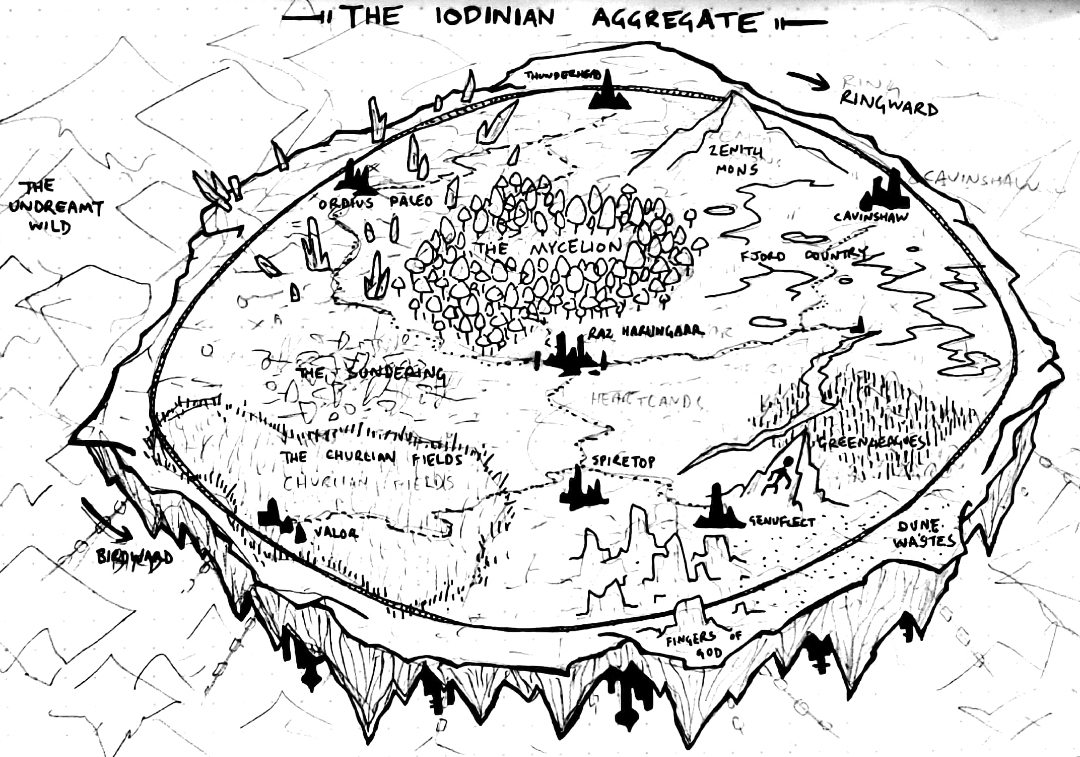
House cleaning on the new and improved Pb, coming sometime early next year. If you've been keeping up with the setting, not much here is a revelation. But I do have a map now, which is more than I could say at any other point in this setting's development. Thanks for reading, and happy gaming.


THE FIRST TRUTH. The landscape is no unbroken mass of endless earth. Rather, it is composed of floating motes of land held in place by titanic chains plunging down into the luminescent, eldritch Æther below. The largest cohesive land mass, the AGGREGATE, was a work of deliberate artifice from the earliest civilizations, the product of lashing countless motes into a patchwork. No sun nor moon hangs in the star-spackled sky.


THE SECOND TRUTH. The AGGREGATE is ruled with an iron-gauntleted fist by the EMPIRE and its right hand the CHURCH (or perhaps it is the other way around). The CHURCH teaches the doctrine of the Warrior-Poet, who compiled the stories of the Saints, mythopoeic personifications of the chemical elements, into the Codex Periodicum. Whispering adherents venerate, for example, Saint Gold the Witchfinder General or Saint Iodine the Mysteriarch.


THE THIRD TRUTH. The OLD WORLD was the age of the Saints, when human civilization was still in its infancy. When the first great human congregation, known to historians as the CONQUEST, crafted the AGGREGATE, it ushered in the NEW AGE, marking the decline of the Saints and the beginning of an age of stability and growth only interrupted by the insurgency of the Warrior-Poet’s successors. As order waxes, magic wanes. The UNDREAMT WILD surrounding the AGGREGATE is still in a tumultuous, hypermagical state of nature, making the AGGREGATE a fragile bastion in a sea of undifferentiated OLD WORLD.


To allow for ease of administration and to alleviate ethnic tensions, the EMPIRE is divided into 5 major principalities, the domains and influences of which are broadly safe from politic’s fickle maneuverings.


IODINIA. The heartland is littered with the EMPIRE’S most bountiful jewels. Raz Haruungar, the greatest city of this or any age and the capital of the EMPIRE, lies beyond the ensnaring hyphae of the Mycelion, a colossal fungal forest-organism. Iodinians have fair or lightly browned skin and eyes in any number of unnatural prismatics, a holdover from the physiognomic tinkering of the CONQUEST.


SACCHARINIA. The closest thing this imploding dynastic power has to a holy book is Machiavelli’s The Prince. Massive spires of sugar-crystal grow out of the sweetened soil of the Sugarspire Flats, into which the Saccharinians carve palaces and dance halls silly with decadent splendor. Saccharinians are known for exaggerated bod-mod, from bleaching their whole body in vibrant pastels to piercing anything that isn’t bone to elaborate full-body works of tattoo artistry.


BURSINGR. The cold here is so bitter it will cut the skin right off your back if you’ll let it. In the shadow of Zenith Mons, king of the motescape’s mountains, glacial fjords thich with piracy cut through the gelid landscape. Bursingi are built thickly and pale, bristling with red hair and marked with spiraling tattoos, breathing tapestries of genealogy and reputation.


GOLGOTH. This is where the old faiths still live, and they don’t mind the heat. It is named for the Golgothan Edifice, the cliff face upon which the first painting of the human form was painted. Golothans are barely unified by their bark-brown skin, hair, and eyes; each clan has developed its own conventions and aesthetics over the centuries.


CHURLIA. Here, the EMPIRE is ripping the riches from the earth’s singing hands. Churlia is dominated by swathes of rolling grasses, in which are littered the rusted ruins of OLD WORLD wars, and its native tribespeople find themselves in the crosshairs of the EMPIRE’s expansionism. Leather-browned and olive Churlians integrate beadwork into their oil-stained overalls, sewing their aviator hats out of Yeabu pelt and woven grass.

Friday, December 30, 2022

The COMPLICATION table, or, reactive random encounters

    After some playtesting, I find myself wanting to make some tightening revisions to NEW AGE. One of the revelations I had recently is that the primary reason I wasn’t utilizing random encounters is because of the extra cognitive load of tracking dungeon-time, which was necessary to ensure that there would be regularity to when I checked for an encounter. That, plus the possibility that a random encounter would possibly coincide with and as such interfere with a planned encounter, made them a tool I didn’t often use- except, that is, to check what happened when the players tried to take a rest in dungeon-time.

That made me realize that what I needed was a reactive system of random encounter checks, not a proactive one. Me rolling for a random encounter wouldn’t be at my will, but in response to the players wanting to take a rest or undergo something with a high time cost. This concept of reactive random encounter checks, my want for tools that I could use for multiple purposes, and my love for the d12 led to the below rules, which I’ll bring to the table with NEW AGE 2e or whatever. This is the absolute first draft, so phraseology and language are subject to change, particularly in the realm of getting closer to succinct, natural language, but I think the concepts have legs.


BREATHERS AND RESTS. If you take an uninterrupted hourish to nurse your wounds and eat a snack, you regain [WEIRD]* SOMA. This is called a BREATHER. If you spend a peaceful night in a warm bed with a full belly, you regain all your SOMA. This is called a REST.


*I’m calling [MAGIC] [WEIRD] in the new version for the same reason I call HP SOMA.


COMPLICATIONS. If you undertake an action that lasts more than a half hour in a dangerous place, like a BREATHER or an excavation, the DM can at their discretion check for a COMPLICATION, which might be mitigated by precautions you take before your undertaking, like barricading.


The Great Generic COMPLICATION table:

1 ENVIRONMENTAL INTERRUPTION. This should be a light annoyance, but enough to interrupt any action requiring the duration to check for COMPLICATIONS.

2 WEAK HOSTILE FORCE. This is a creature that is by default violent, but doesn’t pose a threat to the party, serving mainly to interrupt them and marginally drain their resources or strain their creativity to come up with an alternate solution.

3 FRIENDLY FORCE. This is a force that is actually helpful for the players, be it an environmental effect and a creature.

4 NEUTRAL FORCE. This is a creature whose motivations are such that their interaction with the players could go either way. If it turns to hostility, this creature usually poses a fairly serious threat/resource drain to the party.

5 HOSTILE FORCE. This is a creature that is by default hostile and is a fairly large threat/drain.

6 OVERWHELMING THREAT. This is something with the potential to wipe the floor with the players, environmental or animate. The challenge then becomes circumventing it safely, not necessarily encountering it head-on.

7-12. Nothing happens; the action goes through. [The first 6 entries can also be used as a d6 table for whatever nefarious purposes a wily DM may devise.]


COMPLICATIONS for a volcano dungeon or some shit it’s late:

1 GEOTHERMAL GASSES. Hot sulfur pours up from subterranean chambers. Roll TNCT or go blind for d6 hours, sweating like a pig and being incapable of resting on a success. [Cracks in the ground spewing yellow smoke.]

2 DRIP. Lava drips on a character, causing d10 damage and destroying a random piece of equipment. [A fresh crack in the ceiling starts to glow.]

3 HARDEVOIR. A dwarvish architect doing research on the natural design of the caverns. He knows a good chunk of the place by the back of his hand. [The tapping of his cane against the volcanic stone.]

4 TARRANAX. A red wyrm navigating the caverns in search of the Blueflame Blade, once a part of its hoard. Will do or say anything to retrieve the blade, then attacks as soon as it’s back in its scaly clutches, or if its ego is not sufficiently stroked. [An illusion of trumpet fanfare Tarranax projects before it enters any room populated by smelly apes.]

5 OBSALAMANDER SWARM. Living within the igneous rock, these elemental carnivores manipulate the cavern walls, floor, and ceiling to pin victims in place and drain their blood, even flowing into metal implements when struck. [Swimming patterns in stone, like ripples in water.]

6 PYROCLASTIC FLOW. Lava floods the room over the course of ten minutes, destroying anything short of fireproof therein. [A sudden increase in the room’s temperature, plus the glow of flowing lava if applicable.]


Three things to notice: one, the 7-12 is implied; I just write it as a d6 table so a cunning DM’s instinct becomes to repurpose it in a pinch. Two, I’ve also included a way to foreshadow each COMPLICATION, so that the players have a moment to react to whatever’s being telegraphed, which is just good practice. Three, I've built the generic table so that a DM in a pinch or converting on the fly or improvising could use the generic table on its own to inspire an extemporaneous encounter or in conjunction with another random encounter table that isn't structured as the COMPLICATION table is.


Alright, time to get back to the rest of the NEW AGE overhaul. Thanks for reading, and happy gaming.


Monday, December 19, 2022

More Cheap Tricks


  • Sprinkle 8-12 landmarks, microdungeons, or other oddities on your overland map. When you need to quickly generate an adventure, roll a dWhatever to determine where the macguffin or villain is.

  • For an extra twist that significantly extends the adventure’s duration, roll again for where the macguffin or villain is rumored to be.

  • Even for the most amoral murderhobos, it’s hard to say no to a child, and by extension a missing child.

  • Going around the table board-game style, even in moments of roleplay and exploration, is a great way of reminding yourself to keep the spotlight moving, and encouraging players who fall into the backseat into making decisions that propel the game in interesting new directions.

  • Handing the players a map that you slowly fill in with more details is a lot of fun for both you and them.

  • This map can be made all the more fun with the addition of flaws, discrepancies, and falsehoods, especially when they communicate more information about the world. Why is the Barony of Fenderburg so much smaller on this map from the Agrappen Dynasty? Why did Fordsbridge collapse? Who the fuck thought there was a town in the middle of the forest here?

  • Mobility aids can be a great way to not only provide in-world representation, but also make your world all the more fantastical. Dwarvish tank-wheelchair? Using a cloth-wrapped spire of quartz as a crutch?

  • This is an old and oft-told trick, but it bears repeating. Whenever you can, describe monsters without using their names, then pick up on whatever the players are calling it and call them that yourself. It heightens the mystery of the fantasy and shows that you’re invested in their perceptions and experiences.

  • When your campaign is feeling sluggish or listless, ask yourself what goal your players are pursuing. If the answer is nebulous or unclear, do some work to fix that. A goal is not the enemy of agency; in fact, it is its friend.

  • Contrast is heightened by familiarity. If you want to deliver a big emotional impact, get players used to the equilibrium before changing it. An encounter in which a festival breaks into a bloody melee feels more poignant if the festival has been proceeding peacefully and enjoyably for hours of table time.

  • This advice exists in many forms, but this is my mantra: anxiety may be born from what is known, but deeper horror comes from what isn’t.

  • When building religious traditions, create stories, not characters.

  • Idioms encode a lot of world information in very little space, and add to players’ immersion if they’re inclined to use them.

  • Multiple possible truths, always. Rumors, lies, apocrypha, academic discrepancy…

Wednesday, October 19, 2022

Dominant Clans of the Golgothan Principalities (GLoGtober 3)

 For use with Pb: New Age. This is a view into my creative process: it begins with the art, which tells me so much about the dominant aesthetic influences on a given subject, which in turn informs much about the rest of its nature. This is coupled with as little and as memorable of text as possible, so that it may live organically in my half-memory, and so its re-discovery may bring me almost as much joy as its genesis. My general principle is that if I don’t remember it with a hint of prompting, it wasn’t worth remembering- I like things to be sticky. Hopefully this is of some utility to you.


THE LEAK. Mud reeks and vermin breed, teeming in the burning sun. The Empire ends here, whether it wants to or not.

KANGO. “There is no god as strong as steel, there is no hell as wine-dark as the blood of your spouses and children, there is no heaven as exalting as courage flowing gold-pure in your veins.”

ZADMOR. “Ask a hundred men in a hundred lands, and none of them will ever claim that their chosen bible’s sin is in its verbosity. Why are so few of us starlight made flesh, with souls that live in awe of water and earth?”

THE GREENLEAGUES. Dense forests and foetid jungles cloak life older than thought in the sweltering embrace of a tempestuous tango.

DJUK-DJUK. “Epiphany is the Edifice’s greatest gift, no simpler and no greater. Enter the Waking with me, child.”

OCUL. “The clay of our body is whetted with the Edifice’s spit. Isn’t that the most profound tragedy of them all?”

THE HEARTLANDS. The foothills of the God in Stone. Peace is whispered and sinew-strong.

ASSADEM. “Three, five, seven, nine, thirteen, one-hundred. Patterns within patterns, worlds within worlds. These are the whispers of the Edifice, if we listen hard enough.”

IBYSSARI. “What? Absolutely not. They are cheap imitations of us. We used the scepter and the globus cruciger well before they ever could work the requisite metal.”

THE FINGERS OF GOD. Mesas stretching for a star-laden sky they will never grasp. Red sediment crumbling to ash under calloused hand.

OZATA. “And in due time, the Great Calendar will turn again, yes, and the Turning will make the Edifice’s prophecy come to pass. This is the Age of the Lion, and when Serpent's bite and Hawk’s hunt and Rot’s great settling has come to pass, we will see the age of the Great Man.”

THE DUNE WASTES. The old cliche says that every shattered statue and fallen palace wall is reduced to cinders and floats on birdswind here, to the graveyard of civilization.

FLAGELLATI. “We are born thinking ourselves as gods. We teach ourselves to make order out of chaos. This is our highest heresy, and we must pay for it with a pound of flesh.”

YBIN. “Where do we see the Edifice’s touch? In tea that warms our bellies and bones from the inside out, in the pipe-smoke that laces our tongues with laughter, in the drawings we trace for our children between the stars above. We strain and break and bend so that we may be once again be made whole.”


Thanks for reading, and happy gaming.


Tuesday, October 18, 2022

GLoGTOBER 2: Honestly Don't Even Read This One

Dance with me, baby.


SAMPLE CLASS IDEAS, EACH WITH AN ALTERNATIVE MODE OF COMBAT AND NAMES FOR EXTRA ABILITIES OR SOMETHING:


Aristocrat. Pay 50g or something ridiculous per point of damage automatically dealt; attack rolls are for poor people. Passive income, inheritances, “crypto”.

Antimage. You are anti-magic, in the sense that when you touch magic, most specifically magic items, you annihilate it, causing a momentary burning and flash that could scald or blind those in the immediate vicinity. How this anti-magic effect came to be is a highly intriguing mystery to the world’s leading minds. Smell the occult, phantasmism, spit anti-particle.

Improvisatori. A variation on my flyting system, as found in WWTD and Pb. Offer a CALL and time the DM for a response. The amount of time your DM gets to craft a RESPONSE is proportional to your Level. If the DM cannot, the target takes damage as proportional to your Level. Hearth-shadows, castigate, charge with myth.

Cartomancer. Play War with your DM. Winner deals damage to loser proportional to the magnitude of the victory; your loss is mitigated by a factor determined by your Level. Ace up your sleeve, up the ante, sweeten the pot, insert any number of limp-dick puns here.

Variant Cartomancer. Find a really fast strategy card game, a la Pokemon or Magic. (Extra points for making such a game yourself. I might do that, actually.) On your turn, you and the DM both play a round. When you win the game, your chosen target dies. If you lose, you immediately go unconscious in the most unstable way your game permits.

Sympath. You get extra hit points per Level. Take voluntary damage; a target you say automatically takes the same damage from that same source (so if you burned yourself with a hot poker, a fire elemental wouldn’t be affected, but an ice golem would). Take the pain, chakra-sight, messiah.

Light-Eater. You can consume torches and oil to breathe out fire. You can consume rations to belch out toxic gas. You can eat hireling’s brains to reanimate them as skeletons. Waste not, want not, but at what cost to your party, and your humanity? Bones to steel, red harvest, lights out.

d150 treasures

    For each game, I like to make a d100 treasure table, in the tradition of ICRPG. My vanilla high fantasy game for my elementary schoolers...